
AI Didn't Ruin Your Appeal. It Learned It From Us.
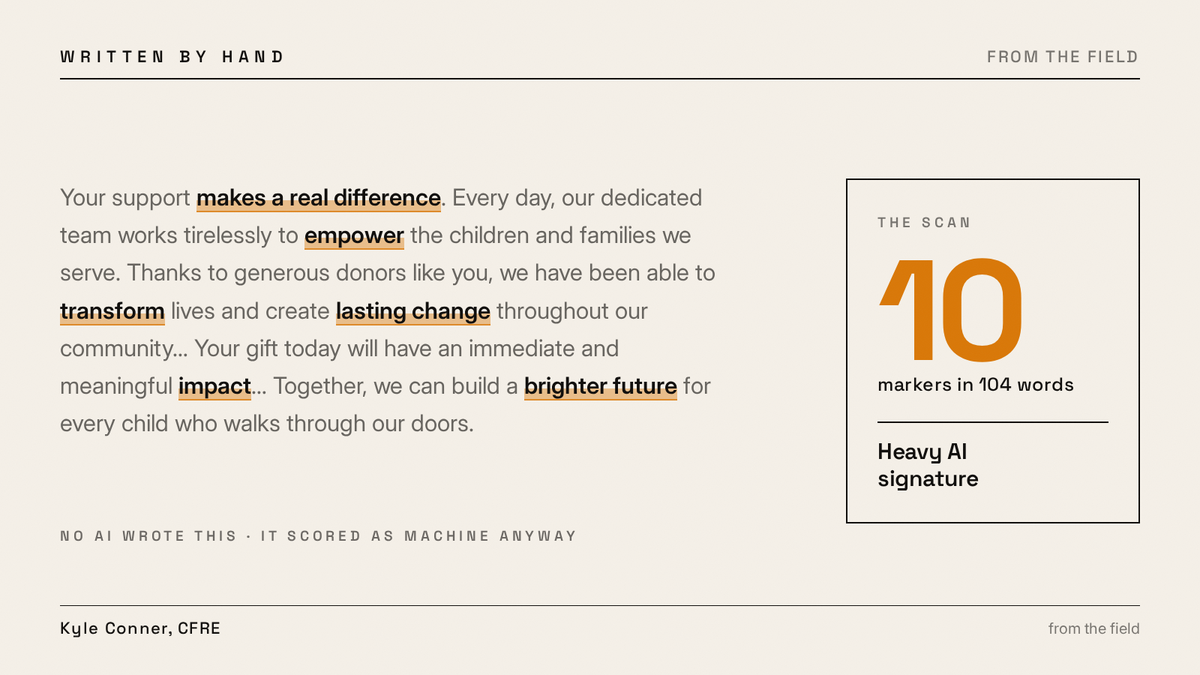
I wrote this paragraph in about ninety seconds. No AI, no template, just what comes out of your hands after you've read a few hundred appeal letters:
Your support makes a real difference. Every day, our dedicated team works tirelessly to empower the children and families we serve. Thanks to generous donors like you, we have been able to transform lives and create lasting change throughout our community.
But the need has never been greater. This year, we must raise $250,000 by December 31 to continue this vital work. It is critical that we meet this goal. Your gift today will have an immediate and meaningful impact on the families who depend on us.
Together, we can build a brighter future for every child who walks through our doors.
Then I ran it through Prose Coach, a writing filter I built to flag the patterns that make prose read as machine-generated. Ten markers in 104 words. A density of 9.6 per hundred. The verdict it handed back was "heavy AI signature."
Nothing generated that paragraph. It scored as machine-written anyway, and the reason is the whole argument of this post.
The flagged words are ours
Six of the ten hits landed in a single category the filter calls saccharine cause language: makes a real difference, empower, transform, lasting change, impact, brighter future. Three more tripped a category called false urgency.
Every one of those was in nonprofit copy long before a language model could finish a sentence. We put them there. Annual reports, case statements, year-end letters, gala scripts, twenty years of it published on the open web and scraped into training data. When a model drafts an appeal today, it is handing the sector back its own vocabulary.
The tell and the boilerplate are the same words. That's the part I keep chewing on. AI didn't invent a new kind of bad fundraising writing. It industrialized ours.
These sentences were dead before ChatGPT existed
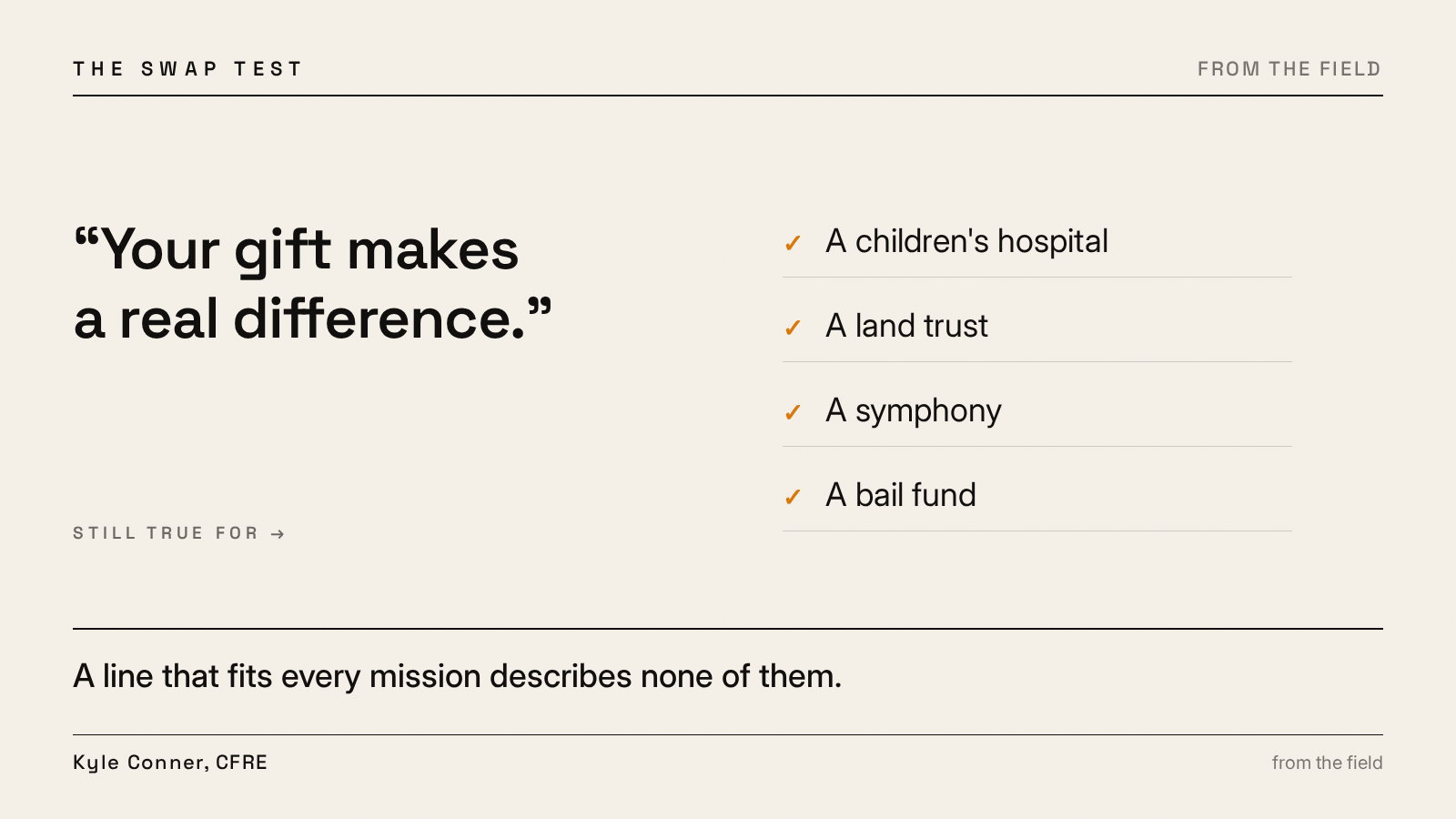
Here's the test I use. Put a different organization's name into your sentence. If the sentence survives, it wasn't saying anything.
"Your gift makes a real difference" is equally true of a children's hospital, a land trust, a symphony, and a bail fund. A line that fits every mission describes none of them. It's skippable, and a donor's eye slides past because nothing in it is new.
That was already true in 2005. The volume changed. A development director can now produce forty variations of that paragraph before lunch, and flatness that used to take a committee three meetings to manufacture shows up in the first draft.
The repair is detail you already have
A better adjective won't do it. You need the specific thing that happened, and it's sitting in your program data and the notes from your last site visit.
Here's the same ask, written out of a campaign I actually ran:
We run 46 beds for children who are medically stable enough to leave the hospital and too complex to go home. More than 90% are on Medicaid, which covers the bed and not much else.
The bridge unit adds 22 beds. It costs $8.1 million.
Twenty-two more children stop living in a hospital room.
Nothing in there reaches for the reader's feelings. It's what's true, at a size a person can hold, with a number attached to a result. Feeling something about it is the reader's job, and they'll do it once you've handed them the material.
Where this breaks down
A few honest limits, because the filter fixes less than it looks like it fixes.
The words aren't banned. One difference in a two-page letter is nothing. Six in 104 words is a pattern, and the pattern is what a reader registers, not any individual word. Go through your appeal deleting vocabulary and you'll end up with prose that is clean and still says nothing.
A filter also can't tell you whether you have a story. It reads the words in front of it. An appeal with zero flagged phrases, built on a program you can't describe in specifics, will still lose the reader by the second paragraph. The scan is the last ten percent of the work. Knowing what happened in your building in March is the other ninety.
And some board chairs want the boilerplate. They read transform lives and feel represented by it. That fight isn't worth burning capital on the spring newsletter. Pick the letters where the money is and fight there.
What I actually do with it
I built the filter because I kept catching the same tics in my own drafts on the third read instead of the first. It's called Prose Coach. Forty-three patterns, each one quoting the line that set it off with the fix attached. Three free drafts a day. No account. The scanner I ran that appeal through is at prose.coach.
Run your last year-end letter through it, or don't. Either way, do the swap test on your opening paragraph this week. Drop a competitor's name into it and see whether the sentence notices. Install the MCP today.
What's the one line in your appeal that could only be about your organization?